Updated
Doorway pages are pages made to rank for specific, similar searches that lead visitors to an intermediate page less useful than the real destination. Google treats them as spam under its doorway abuse policy. The textbook case is a set of city pages with the same text and only the city name swapped, all pushing visitors to one contact form.
That doesn’t make every location page a doorway. A directory page for plumbers in Austin is legitimate when it lists real plumbers in Austin that no other page on the site shows in the same way. This guide quotes the policy, turns it into a test you can run on your own city and category pages, and covers how to fix pages that fail.
What Google’s doorway policy says
Google’s spam policies define it this way: “Doorway abuse is when sites or pages are created to rank for specific, similar search queries. They lead users to intermediate pages that aren’t as useful as the final destination.” The examples Google lists:
- “Having multiple websites with slight variations to the URL and home page to maximize their reach for any specific query”
- “Having multiple domain names or pages targeted at specific regions or cities that funnel users to one page”
- “Generating pages to funnel visitors into the actual usable or relevant portion of a site”
- “Creating substantially similar pages that are closer to search results than a clearly defined, browseable hierarchy”
Two words carry most of the meaning: funnel and substantially similar. A page that exists to pass visitors along to something else, or that is a near-copy of its siblings, is the problem. A page that is itself the useful destination is not.
When Google announced a ranking change for doorways in 2015, it gave five questions to tell them apart (Google Search Central Blog, March 2015). Applied to a directory:
| Google’s question, in short | What it means on a directory |
|---|---|
| Is the page there to funnel visitors, or is it part of the site’s experience? | Does someone browsing the site land on it naturally, from the city or category page above it? |
| Does it target generic terms while the content is very specific? | A page titled “Best plumbers in Texas” that lists three businesses in one suburb. |
| Does it duplicate useful aggregations that already exist on the site to capture more traffic? | A second page for the same category and city, or suburb pages that repeat the metro page’s listings. |
| Is it made only to send affiliate traffic along without unique value? | A “top 10” page where every business links to the same booking partner and nothing else is on the page. |
| Is it an “island”, hard to reach from the rest of the site? | Pages linked only from the sitemap or a footer block of 500 city links. |
Doorway pages vs landing pages vs location pages
| Doorway page | Landing page | Location page | |
|---|---|---|---|
| Built for | Ranking for a search variant | A campaign or offer | A real place the business or directory covers |
| Content | Same as siblings, keyword swapped | Specific to the offer | Specific to the place: listings, branch details, local facts |
| Where it leads | Funnels to one destination | A sign-up or purchase on the page | The listings or branch on the page itself |
| Linked from | Sitemap, footer link blocks | Ads, email, the site | The site’s own hierarchy (state → city → category) |
| Indexed? | Shouldn’t exist | Often noindex for paid campaigns | Yes, when it has real content |
See location pages SEO for how to build city and service-area pages that pass.
Is your city × category page a doorway? A practical test
Category-in-city pages are the most valuable pages on most directories, and the ones most likely to drift into doorway territory as the site grows. Run each page type through these checks. A page that fails the first two is a doorway risk no matter how good its intro text is.
- Real listings in that place. The page shows businesses actually located in, or genuinely serving, that city, and enough of them to be worth browsing. Pick a minimum (many directories use 3) and hold every page to it.
- Listings unique to the page. Ten suburbs whose pages all show the same 12 metro businesses are ten copies of one page. The suburb page needs businesses that are actually in the suburb, or it should not exist.
- Content that changes with the place. Listing counts, price ranges from the listings, review excerpts, opening hours, neighborhoods served, local licensing notes. Data from the listings themselves is the cheapest unique content you have.
- Part of a browseable hierarchy. Reachable from the state or city page and the category page, and linking down to its listings. Not an island reachable only from the sitemap.
- No funnel to one destination. Visitors can contact the businesses listed. A page where every button leads to one lead form or one advertiser is the funnel Google describes.
- One page per category and place. Not
/plumbers/austin,/austin-plumbersand/plumbing-austin-txside by side. - Not a search results page in disguise. Internal search URLs such as
/search?q=plumber+austinare “closer to search results than a clearly defined, browseable hierarchy”. Keep them out of the index.
| Signal | Legitimate city × category page | Doorway risk |
|---|---|---|
| Listings | At or above your minimum, located there | None, one, or borrowed from a nearby city |
| Text | Facts drawn from the listings and the place | The same paragraph with the city swapped |
| Siblings | Each page shows a different set of businesses | Suburb pages repeating the metro list |
| Links in | From city and category pages | Sitemap only, or a giant footer block |
| Next step for a visitor | Contact a business on the page | One form, one partner, or another page |
Common doorway patterns on directories and local sites
- Every category × every city, built from a list. 200 categories times 1,000 cities is 200,000 pages, most of them empty. The page count comes from a spreadsheet, not from listings.
- Suburb and neighborhood pages that pull in businesses from the whole metro area.
- Keyword-variant pages: “plumber”, “plumbers”, “plumbing contractor” and “plumbing company” pages for the same city.
- “Near me” pages such as
/plumbers-near-me-austin. Google already uses the searcher’s location; a page per phrasing adds nothing. - Service-area pages for one business: 40 “Roofing in [town]” pages with the same text, each ending in the same quote form.
- Several domains for the same directory, one per city or region, with the same template.
Most of these start at build time, when a site generates every combination it can rather than every combination it has data for. How to build a directory website covers planning page types so this doesn’t happen, and programmatic SEO covers what makes a generated template worth indexing.
Service businesses: one page or forty?
A single business that serves many towns faces the same policy with fewer pages. Forty “Roofing in [town]” pages with the same text and the same quote form match Google’s example of pages “targeted at specific regions or cities that funnel users to one page”. Keep separate town pages only where you have something specific to show there: projects completed, crews based nearby, reviews from customers in that town, local permit rules. Fold the rest into one service-area page that names every town you cover.
How to fix doorway pages
- Group the pages by page type and count, for each page, its listings, its impressions in the last 90 to 180 days and whether Google indexed it. The problem is usually a whole template or a whole batch, not single pages.
- Improve the ones worth keeping: recruit businesses into places where people search and you have a page with too few listings, and add facts that come from those listings.
- Merge near-copies: 301 suburb pages that repeat the metro listings into the metro page, and keyword variants into the one page you keep.
- Noindex pages that may fill up later, such as a city where you are actively signing businesses. Take them out of the sitemap until they meet your minimum.
- Remove pages with no prospect of real content and let them return 404 or 410. An empty page that returns 200 can also show up as a soft 404.
- Stop generating new ones: make a page indexable only when it reaches your minimum listing count.
Expect the indexed share of the template to rise and its never-shown share to fall over the following weeks. Pruning many pages at once is a form of index bloat cleanup; track it by page type so you can tell what worked.
If Search Console shows a manual action, the Manual actions report names the issue; Google lists “Doorways” as an example under “Thin content with little or no added value”. Fix every affected page, not some of them, then request a review. Google says most reviews take several days or weeks. If there is no manual action but traffic fell during a spam update, there is nothing to request: Google’s spam update page says sites that fix the problem may see improvement once its automated systems learn that over a period of months. For the wider picture see scaled content abuse, the policy that covers mass-produced pages in general.
Find doorway risk with DirectoryLens
DirectoryLens looks at the signals above for each page type, from your Search Console data and a light crawl of a sample of your pages:
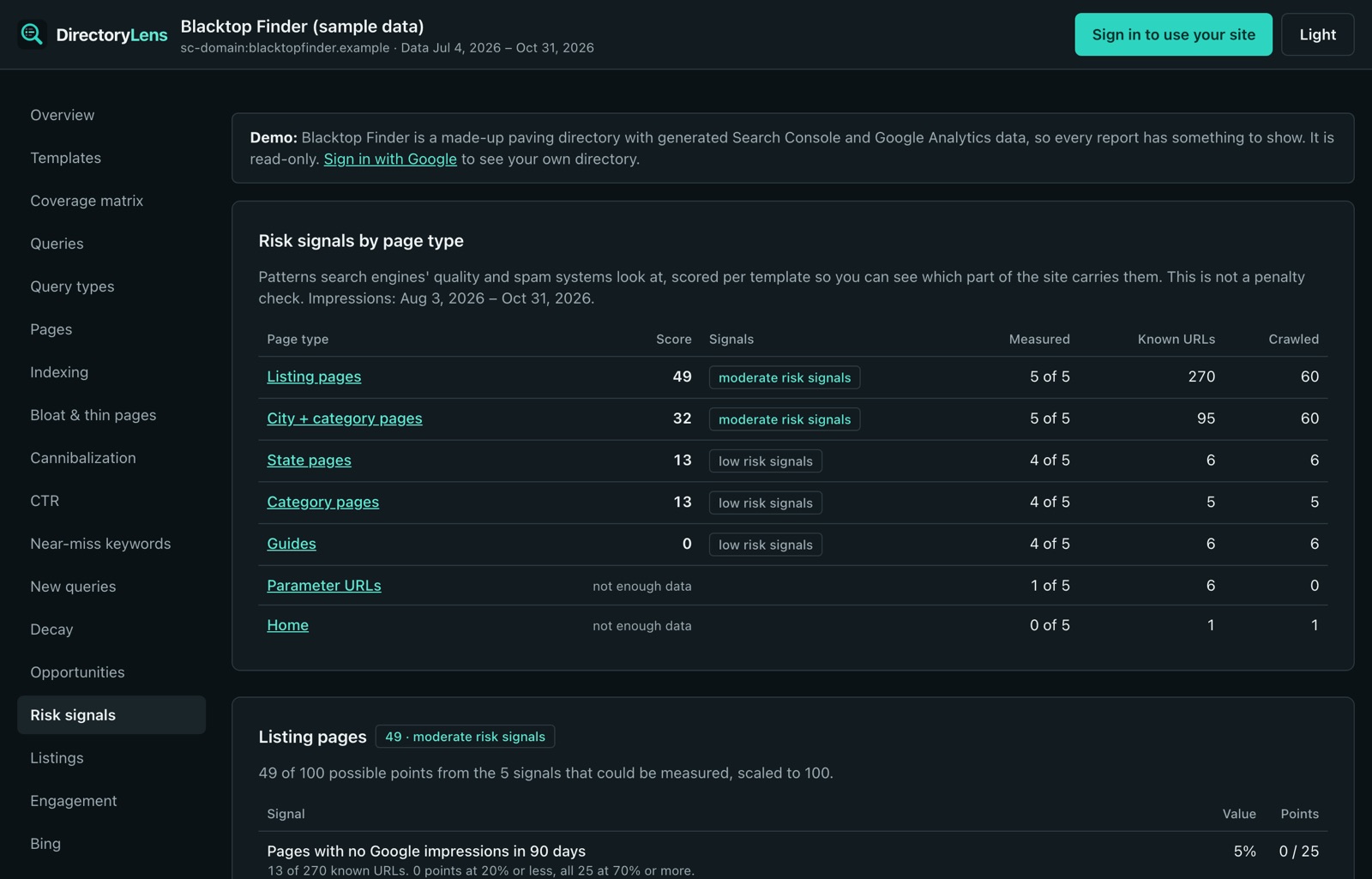
- Quality signals (under Advanced) shows, per page type, the share of pages never shown in Google in 90 days, thin pages (fewer listings than your threshold, or under 150 words), pages whose main text is at least 80% the same as another page of the type, titles that differ only by place or category, and the estimated indexed share. Each is marked Fine, Worth a look or Needs attention. It is not a penalty check, and it says so.
- Thin and unused pages recommends an action for each page: keep, improve, get indexed, noindex, merge, or 410 / redirect, and waits on pages too new to judge.
- Check pages before you publish (in Build and recruit › Where to build) takes a list of planned category and city pages, up to 300 at a time. A page with fewer listings than your threshold gets “Recruit first”, and one with no listings is called out as a doorway page under Google’s spam policies. It needs your listing roster with categories uploaded.