Updated
Scaled content abuse is Google’s spam policy against generating many pages “for the primary purpose of manipulating search rankings and not helping users”. It applies however the pages are made: AI, templates, scraping, people or any mix. For directories and programmatic sites, the risk is a template that turns a list of keywords and place names into thousands of near-identical pages with no real data behind them. The fix is to measure each page type and fill, merge or remove the pages that add nothing.
The scaled content abuse policy, word for word
From Google’s spam policies: “Scaled content abuse is when many pages are generated for the primary purpose of manipulating search rankings and not helping users. This abusive practice is typically focused on creating large amounts of unoriginal content that provides little to no value to users, no matter how it’s created.” Google’s examples:
- Using generative AI tools or similar tools to generate many pages without adding value for users.
- Scraping feeds, search results or other content to generate many pages, including through automated transformations such as synonymizing, translating or other obfuscation, where little value is provided to users.
- Stitching or combining content from different web pages without adding value.
- Creating multiple sites to hide the scaled nature of the content.
- Creating many pages whose content makes little or no sense to a reader but contains search keywords.
The examples are paraphrased lightly from Google’s list; the definition above is quoted exactly.
Where it came from: the March 2024 update
Google announced the policy on March 5, 2024, together with that month’s core update (Search Central Blog). It replaced the older policy on automatically generated content so that Google could act on mass-produced pages whether they came from automation, humans or both. Google said the update and its earlier work would cut low-quality, unoriginal content in results by 40%, and after the rollout said the reduction reached 45% (Google blog).
Two other policies arrived in the same announcement, and both still matter:
- Site reputation: third-party content published on a host site mainly to benefit from that site’s ranking signals, for example unrelated sponsored or coupon sections on a trusted site. Enforcement began on May 5, 2024. Google now lists it as the “Site reputation policy” and updated it in August 2026: outside the European Economic Area a manual action affects the pages concerned, while inside the EEA Google may rank that section separately from the rest of the site (Google’s August 2026 post).
- Expired domain abuse: “where an expired domain name is purchased and repurposed primarily to manipulate search rankings by hosting content that provides little to no value to users.” Buying an old domain and filling it with a directory template unrelated to its past is the directory version.
What isn’t scaled content abuse
- Using AI. Google’s guidance on generative AI content warns against generating many pages without adding value. It doesn’t ban AI; it asks you to fact-check and review what you publish, including titles.
- Using templates. Every directory, marketplace and ecommerce site does. A template with unique, useful data on each page is how large sites work.
- Having many pages. 100,000 listing pages for 100,000 real businesses is a directory. 100,000 pages for 2,000 businesses is the problem.
How directories and programmatic sites trip it
- Every category × every city. Pages generated from a keyword list rather than from listings, so most show zero or one business.
- AI-written city intros that are the same 200 words with the city name swapped, on pages whose listings are thin.
- Scraped listings published as-is, copied from another directory or map service with nothing added: the “scraping feeds … or other content” example.
- Synonym and variant pages: “plumber”, “plumbers”, “plumbing service” in every city.
- Machine-translated copies of the whole directory in other languages, with listings that only exist in one country.
- A network of niche directories on separate domains running the same template and the same data.
None of this means generated pages are the problem; programmatic SEO done with real data is how directories grow. Most of these also fit Google’s doorway policy. The two overlap: doorways are about funnelling similar searches; scaled content abuse is about volume without value.
Self-audit: check each page type
Spam systems judge patterns, so audit the pattern. List your page types (listings, cities, categories, category × city, guides) and run these checks on each. The thresholds below are the ones DirectoryLens uses for its quality signals; they are rules of thumb, not numbers Google publishes.
| Signal | How to measure it | Worth a look when |
|---|---|---|
| Pages never shown | Pages with zero impressions in Search Console over 90 days, divided by the page type’s known URLs | More than about 20% of a city or category template |
| Near-duplicate text | Compare the main text of a sample of pages; count pages with a twin at least 80% the same | More than about 10% of the sample |
| Thin or empty pages | Pages with fewer listings than your minimum, or under about 150 words of main text | More than about 10% of crawled pages |
| Indexed share | URL Inspection on a sample of each type; or the Page indexing report per sitemap | Under about 80% indexed, or falling |
| Same titles | Strip place and category names from titles and count the most common pattern | Normal on directories; only worth a look above about 70% |
Then do the check no tool can: open ten random pages of each type and ask whether a visitor who landed there from Google would find what they searched for. If the honest answer for a template is no, that template is the problem.
Listing pages need a separate reading. Many real listings get no search impressions because visitors reach them through city and category pages, and short business profiles are normal. Near-duplicate text across listings, though, often means descriptions copied from one source. For more on pages Google never shows, see index bloat and zombie pages.
Manual action or algorithm?
| Manual action | Algorithmic (spam systems, spam updates) | |
|---|---|---|
| How you know | Search Console’s Manual actions report and a message | No notice; a drop that lines up with a spam update |
| What it names | “Major spam problems” lists scaled content abuse as an example; “Thin content with little or no added value” covers doorways and scraped content | Nothing |
| Scope | Listed in the action: part of the site or all of it | Inferred from which page types lost traffic |
| How to recover | Fix all affected pages, then request a review | Fix the pages; no request is possible |
| How long | Google: most reviews take several days or weeks | Google: improvement may come over a period of months |
Sources: Google’s Manual actions report help and spam updates page.
A drop during a core update is different again: core updates reassess how helpful pages are rather than enforcing spam policies, although the fixes often look alike. See Google core update recovery.
Recovery plan
- Find the page types that carry the problem with the audit above, and note how many URLs each has.
- Decide per page: improve the ones that can have real content (recruit listings, add data), merge near-copies with 301s, noindex ones that may fill later, and remove the rest with a 404 or 410.
- Fix the generator, so new pages only go live when they meet your minimum. For city pages, location pages SEO lists what each needs.
- Clean the sitemaps so they list only the pages you kept.
- For a manual action, document what you removed and changed, then request the review once. Don’t resubmit while it is pending.
- Measure from the cleanup date: indexed share and clicks per page type against the weeks before.
How DirectoryLens helps
Quality signals (under Advanced) runs the audit above for each page type of a directory and marks each signal Fine, Worth a look or Needs attention, with the numbers behind it. Near-duplicate text is estimated with MinHash fingerprints of each crawled page’s main text, comparing a sample of up to 60 pages per type with up to 3,000 crawled pages of the same type. The thin, near-duplicate and title signals need the light crawl turned on in Site settings. It is not a penalty check: it shows the patterns Google’s systems look at, so you know where to look.
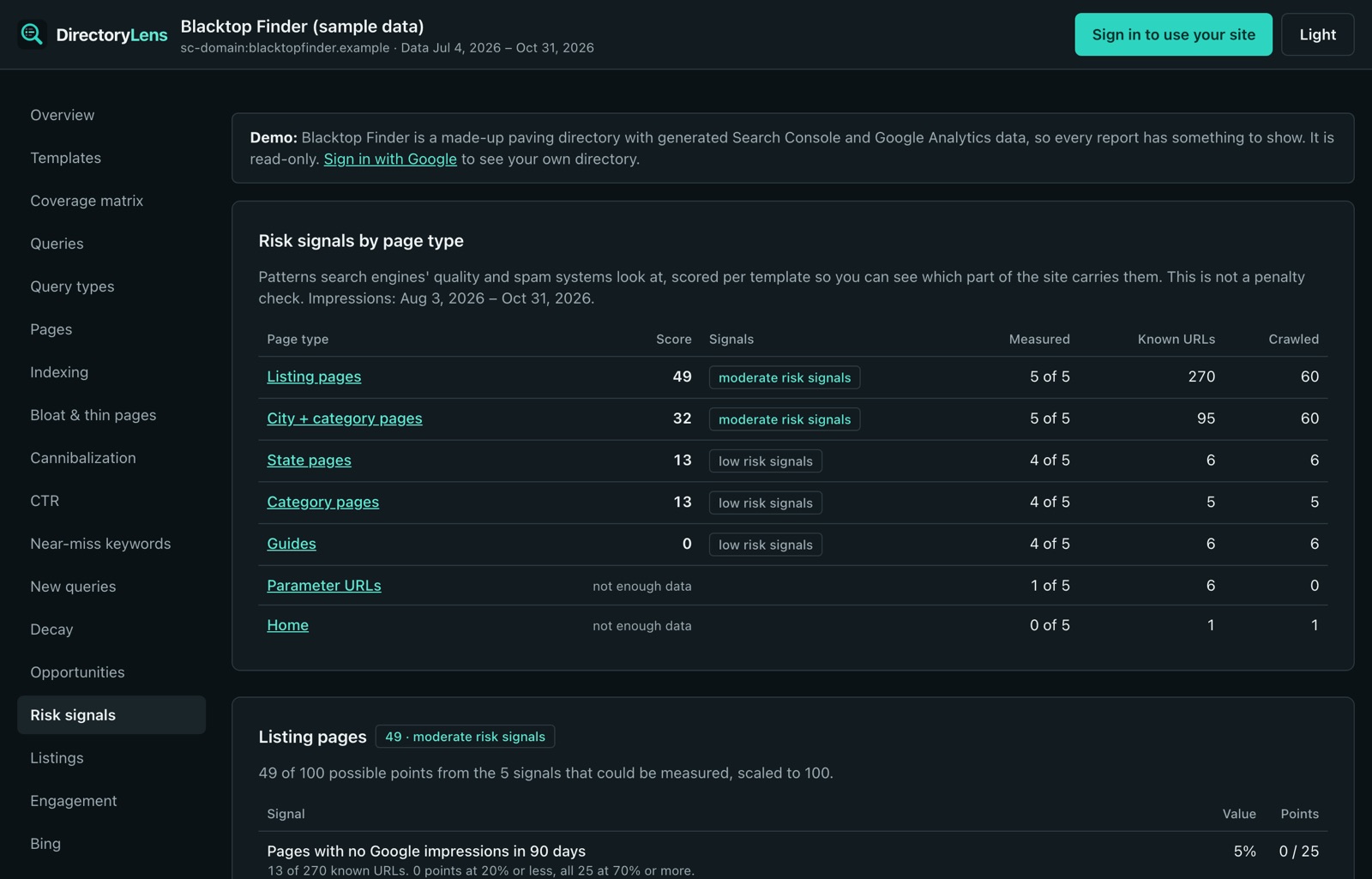
Thin and unused pages then gives a recommended action for every page, and Recovery tracker compares the weeks before a cleanup or an update with the weeks since, so you can see whether the pages you kept are recovering.